
|
||||
|

Placard pride
12/12/2012 11:22:38 AM
By Craig Howard
Splash Contributor
In Glendale, Calif., towering palm trees serve as the backdrop of a gateway marker accented by pastel swirls and highlighted by a column that recalls the geometric Art Deco style made popular in the 1930s. To the north of Glendale, in Tualatin, Ore., metal geese soar out of a facsimile lake in a sign at the edge of the city.
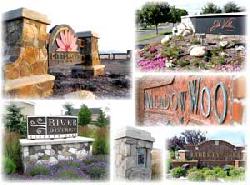
Mike Terrell appreciates the time and creativity that go into a good sign. In addition to his work on local landmarks like Pavillion Park and Rocky Hill Park, the Liberty Lake-based landscape architect has designed placards and markers that can be found everywhere from the River District to points along the community's signature trail system.
Recently, Terrell served as the design consultant for the city of Spokane Valley's long-awaited gateway sign. The marker near the western boundary of the city incorporates the industrial history of the area with a metal likeness of the municipal logo while stone and turf elements pay homage to the nearby Dishman Hills.
Advertisement
"I think gateway signs are good for the culture, recognition and pride of a community," Terrell said. "They give a sense of permanence and establishment."
At the Nov. 20 meeting of the Liberty Lake City Council, Terrell provided his pitch for another project. Appearing with representatives of the Washington State Department of Transportation, Terrell discussed preliminary ideas for a roundabout at the convergence of Mission, Harvard and the Interstate 90 offramp. A workshop on the roundabout is scheduled today (Dec. 13) at City Hall.
|
IF YOU GO ... |
"The brick represents permanence and stability," Terrell said. "The granite is historical material that is indigenous to the area."
For the sign at the doorstep of Greenstone's River District, Terrell incorporated a material called corten steel, which rusts naturally and produces a rich, distinctive color. The logo and lettering of the residential area are set in aluminum which Terrell said "reflect more of modern sense." The foundation of the sign features a neat patchwork of cobblestone, a tribute to the minerals formed by the nearby Spokane River.
"With that project there was really a sense of bringing it all together," Terrell said.
From the neon of Las Vegas to the corrugated steel of Pittsburgh, signage in a particular region often mirrors the atmosphere and history of the area it represents. Terrell notes that most signs in Boise, for example, are made from the sandstone mined in the hills surrounding the city.
"Every business sign there is sandstone," Terrell said. "If you want to stand out in Boise, it might be better to go with something other than sandstone."
For several sign projects in Liberty Lake, Terrell has drawn upon a theme found on an entry gate post to a house that he said probably dated back to the 1920s. The post included a unique concrete capstone that fit over the brick column like a stylish lid. Terrell has also blended elements of the old granite wellhouse that once stood on the acreage where Rocky Hill Park is now located.
"The biggest challenge is finding the right granite," said Terrell, who studies the geological, cultural and architectural history of the area to emerge with design ideas.
Since incorporating as a city in August 2001, Liberty Lake has been known for a sign code that leans more conservative than gaudy. Over the years, most municipal leaders have emphasized the importance of avoiding the sprawl of signage that has characterized Spokane Valley to the west, particularly the commercial clutter along Sprague Avenue.
"I think there has been more care taken in Liberty Lake with signage," Terrell said. "We have an opportunity to approach it from an aesthetic standpoint where you don't end up with something like you find on the I-5 corridor."
As for the potential of the roundabout project, Terrell said the landmark "could have many layers to it," including a water feature and a collection of trees. He noted that the late Lud Kramer, former Washington Secretary of State and one of the founding figures of the city of Liberty Lake, often mentioned the idea of Evergreens signaling the start of the city as visitors approached from Idaho.
"It was just this sense that Washington is green, and that's what you should see when you arrive here," Terrell said.
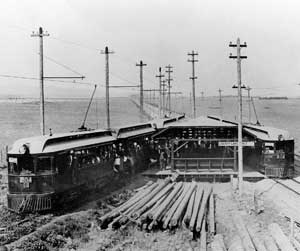 Photo courtesy of Ross and Kelli Schneidmiller This historical photo shows Liberty Lake Junction, the spot where a spur line was built off the main track to take resort-goers into Liberty Lake beginning in the early 1900s. Today, this same site is planned to be developed in 2013 into a roundabout where Harvard, Mission and an off-ramp converge just north of Interstate 90. Among the options for the design of the roundabout is to incorporate some of the site's heritage into the plans. |
Ross Schneidmiller, president of the Liberty Lake Historical Society, said the proposed roundabout location is part of a railway history "that put Liberty Lake on the map."
"The electric railway really made Liberty Lake unique from all the other lakes in the area," Schneidmiller said.
Schneidmiller and other members of the historical society are in the visionary stages of a project that would add unique historical markers to the Liberty Lake landscape. Terrell is among the local consultants who have been brought in to discuss the idea, which would involve placing signage with both decorative and informational components at sites like Pavillion Park.
"I think there are real opportunities to present our history and also beautify the city," Schneidmiller said.
Schneidmiller applauded the efforts of Terrell and others to incorporate the heritage of the area in signage and other architecture throughout Liberty Lake.
"It's a good example of the fact that something is going on and people are saying, ‘OK, what went on historically here?'" he said.
Time will tell if the roundabout will include a small forest of Evergreens, a cobblestone wall or a nostalgic reference to the old train depot. In the meantime, Terrell will continue to hearken back to the past as he contemplates the signs of the future.
"Signs are important," Terrell said. "They're a lot like landscaping - you're designing something that's going to be around for quite a while."